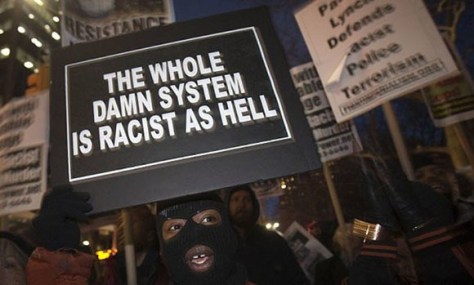
Racism may well be the biggest crime in the criminal legal system. If present trends continue, 1 of every 4 African American males born this decade can expect to go to prison in his lifetime, despite the fact that the Census Bureau reports that the U.S. is 13 percent Black, 61 percent white and 17 percent Latino.
When Brown v Board of Education was decided in 1954, about 100,000 African Americans were in prison. Now there are about 800,000 African Americans in jails and prisons: 538,000 in prisons, and over 263,000 in local jails. Black men are nearly 6 times as likely to be incarcerated as white men and Hispanic men are 2.3 times as likely, according to the Sentencing Project.
Why? Because our country has dramatically expanded our jails and prisons and there is deep racism built into every step of the criminal legal system. Some think the criminal legal system has big problems that need to be reformed. Others think the racism in the criminal legal system is helping it operate exactly as it has been designed to incarcerate as many black and brown people as possible.
Here are 18 examples of racism in parts of different stages of the system. Taken together, the racism in each of these steps accelerates the process of incarceration of African American and Latino males. Together, they demonstrate that racism may well be the biggest crime in the criminal legal system.
1. Police Stops
Who is stopped by the police, either in cars or on foot, continues to be highly racialized as proof of racial profiling continues to accumulate. University of Kansas professors found the police conducted investigatory stops of African American males at twice the rate of whites. A black man in Kansas City, 25 or younger, has a 28 percent chance of being stopped, while a similar white male has only a 12 percent chance.
In New York City, police continue to stop Black and Hispanics at rates far higher than whites even though they are stopping many less people due to a successful civil rights federal court challenge by the Center for Constitutional Rights. One of the most illuminating studies is in Connecticut which showed racial disparities in traffic stops during the daytime, when the race of the driver can be seen, but not at night.
2. Police Searches
Once stopped, during traffic stops, 3 times as many Black and Hispanic drivers were searched as white drivers, according to the U.S. Bureau of Justice Statistics. According to the same U.S. Bureau of Justice Statistics, white drivers were also given tickets at a slightly lower rate than Black and Hispanic drivers.
3. Police Use of Force During Arrest
A recent report by Center for Policing Equity found that police are more likely to use force like Tasers, dogs, pepper spray and physical force against Black people than White people in making arrests.
4. Juvenile Arrests
Black youth are twice as likely to be arrested for crimes in school as white kids, over 2.5 times as likely to be arrested for curfew violations as white kids, twice as likely as white kids to be arrested for all crimes, and much more likely to be held in detention than white kids, according to the Sentencing Project.
5. Arrests in the Transgender Community
Hundreds of thousands of gay and transgender youth are arrested or detained every year and more than 60 percent are Black or Latino, according to the Center for American Progress.
6. Arrests for Drugs
Start with the fact that whites and blacks use and abuse drugs at about the same rates. This is proven by the 2013 National Survey on Drug Use and Health of the U.S. Department of Health and Human Services. This study found drug and alcohol abuse among whites and blacks nearly the same with blacks reporting one percent higher on drug use than whites while whites have three percent higher rates of binge alcohol and one percent higher rates of substance abuse or dependence.
But when it comes to drug arrests, Blacks are arrested at a rate more than twice their percentage in the population. Twenty nine percent of drug arrests, according to FBI statistics, are of African American people.
7. Police Arrests for Marijuana
While marijuana use is similar in black and white communities, blacks are 3.73 times as likely to be arrested for possession of marijuana as whites.
8. Pre-Trial Release
The National Academy of Sciences found that blacks are more likely than whites to be incarcerated while awaiting trial.
9. Prosecution Charges
Federal prosecutors are almost twice as likely to file charges carrying mandatory minimum sentences for African Americans than whites accused of the same crimes, according to a study published by the University of Michigan Law School.
10. Prison vs. Community Service
The National Academy of Sciences stated that blacks are more likely than whites to received prison terms rather than community service. Black people are imprisoned at twice the rate of white people in the U.S., according to the US Department of Justice.
11. Length of Incarceration
The National Academy of Sciences stated that, after conviction, blacks are more likely than whites to receive longer sentences.
12. State Drug Incarceration
The Bureau of Justice Statistics reports 208,000 people are in state prisons for drug offenses. Of this number, 32 percent are white and 68 percent are African American or Hispanic.
13. Federal Drug Convictions
More than half of all federal prisoners are there for drug offenses. The U.S. Sentencing Commission reported 25 percent of all federal drug convictions in 2014 were of African Americans and 47 percent were Hispanics versus 24 percent of whites. In federal prisons, 22 percent are white and 76 percent are African American or Hispanic.
14. Federal Court Sentencing
African American men were sentenced to 19 percent longer time periods in federal courts across the U.S. than white men convicted of similar crimes in a 4-year study conducted by the U.S. Sentencing Commission.
15. Incarceration of Women
Black women are incarcerated at a rate nearly 3 times higher than white women.
16. Sentencing to Life Without Parole
Over 65 percent of prisoners serving life without parole for nonviolent offenses are black.
17. Hiring People With Criminal Records
Having a criminal record hurts a person’s ability to get a job ― but it hurts black men worse. In fact, white men with a criminal record have a better chance of getting a positive response in a job search than black men without a criminal record. This has been confirmed by a study of 6,000 applications in Arizona and an earlier study in Milwaukee and New York City.
18. Eliminating the Right to Vote
The impact of this is devastating. For example, 1 out of every 13 African Americans has lost their right to vote due to felony disenfranchisement versus 1 in every 56 non-black voters.
Taken together, these facts demonstrate the deep racism embedded in the criminal legal system. None dare call this justice.
None dare call this justice. by Bill Quigley Racism may well be the biggest crime in the criminal legal system. If present trends continue, 1 of every 4 African American males born this decade can …
Source: 18 Examplez Of Racism In The Criminal Legal System



 “When everything finally falls into place; you’ll soon realize behind your pain is your grace. “





You must be logged in to post a comment.