
Category Archives: Zen
Sublime Abiding ; Sutra via GreatMiddleWay
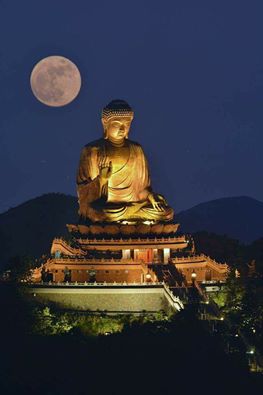
Let me be able and upright,
straightforward and gentle in speech,
humble and not conceited,
contented and easily satisfied,
unburdened with duties and frugal in my ways.
Peaceful and calm and wise and skillful,
not proud or demanding in nature,
let me not do the slightest thing
that the wise would later reprove.
In gladness and in safety,
may all beings be at ease.
Whatever living beings there may be
—whether they are weak or strong, omitting none,
the great or the mighty, medium, short or small,
the seen and the unseen,
those living near and far away,
those born and to-be-born—
may all beings be at ease!
Let me not deceive another,
or despise any being in any state.
Let me not through anger or ill-will
wish harm upon another.
Even as a mother protects with her life
her child, her only child,
so with a boundless heart
will I cherish all living beings.
I will radiate kindness over the entire world
—spreading upwards to the skies,
and downwards to the depths,
outwards and unbounded—
freed from hatred and ill-will.
Whether standing or walking,
seated or lying down,
free from weariness,
I will sustain this recollection.
This is the sublime abiding.
—Buddha Shakyamuni, Maitri Sutra
Source: Sublime Abiding
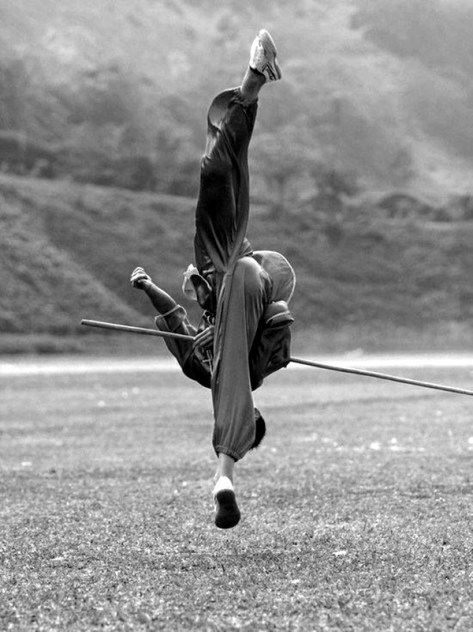
Shaolin.
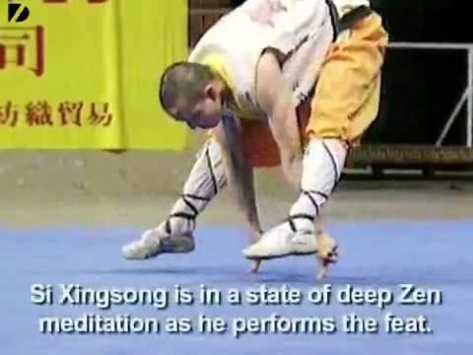
Wait! Stop Scrolling I Have to Tell You Something!
“The happy inner soul inside of you is waiting to come back and start again!
Harmonious balance is indeed an affliction but one cannot feel pleasure without pain”.
 You know that feeling of angst;
Pain and anxiety that seems to linger.
It is simply impermanence;
It is part of balance.
I just wanted to remind you;
It is going to be okay.
And that “Everything“;
Happens for a “reason”…
Hold on, Be strong.
-Nina
When compassion is born, you don’t suffer any more — Zen Flash
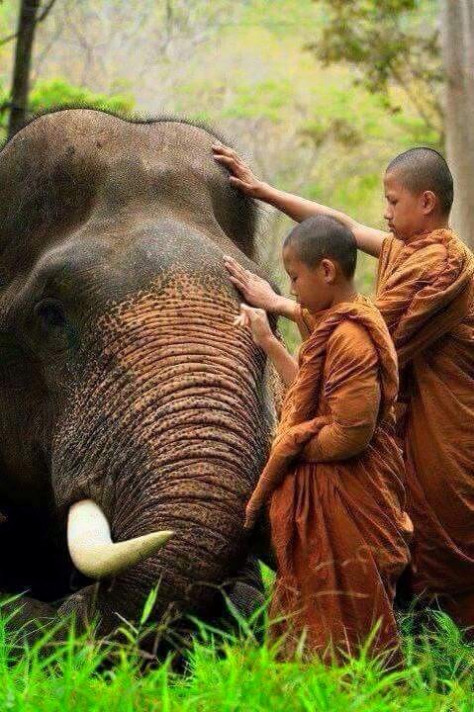
“Suppose someone says something that angers you. Your old pathway wants to say something to punish him. But that makes us victims of our habit energy. Instead, you can breathe in and say, “Unhappiness is in me, suffering is in me, anger is in me, irritation is in me.”
That is already helpful, recognizing your feelings and helping you not to respond right away. So you accept that anger and irritation in you, and smile to it.
With mindfulness, you look at the other person and become aware of the suffering in him or in her. He may have spoken like that to try to get relief from his suffering. He may think that speaking out like that will help him suffer less, but in fact he will suffer more.
With just one or two seconds of looking and seeing the suffering in him, compassion is born. When compassion is born, you don’t suffer any more, and you may find something to say that will help him.
With the practice, we can always open new neural pathways like that. When they become a habit, we call it the habit of happiness.”
~Thich Nhat Hanh ~
Source: When compassion is born, you don’t suffer any more — Zen Flash
Shantideva – Rise Like A Lotus
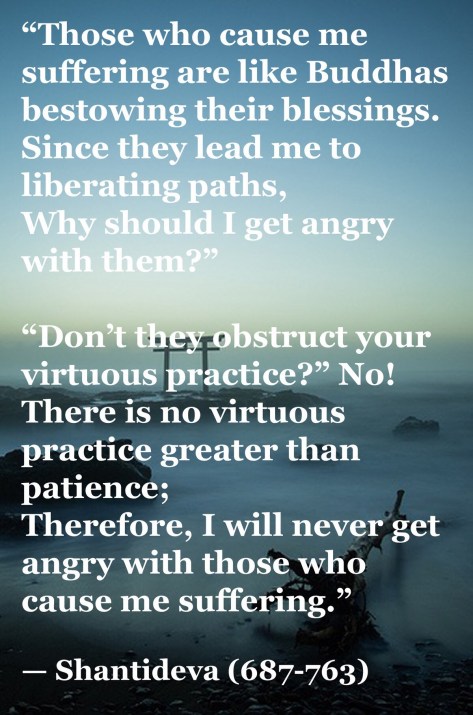 Photo post by @2buddhaornot.
Source: Shantideva
Beyond Meditation – 2buddhaornot2buddha
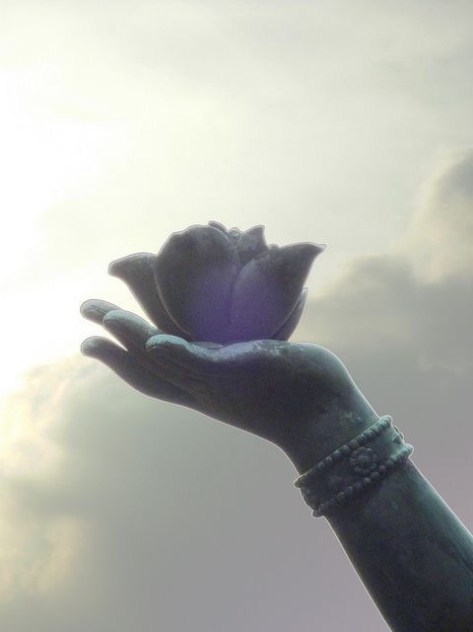 Moving Beyond Meditation by Yongey Mingyur Rinpoche My introduction to the world of the Great Perfection (Dzogchen in Tibetan) occurred when I was just a small boy. The first years of my life…
Source: Beyond Meditation
“Mine” – The Great Middle Way
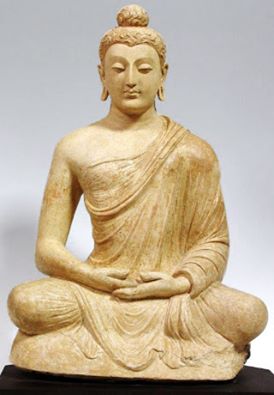
See them, floundering in their sense of “mine”,
like fish in the puddles of a dried-up stream.
And, seeing this, live with no “mine”,
not forming attachment to experiences.
—Buddha Shakyamuni
Source: “Mine”
Shaolin. 10 Tips to Living Longer.
 http://www.criticalcactus.com/shaolin-monk-reveals-10-tips-to-live-longer/
Shaolin monk; Tips to living longer…
1) Don’t think too much. Thinking takes energy. Thinking can make you look old.
The benefits of meditating (not thinking) are many and various. Read this Psychology Today article on 20 scientific reasons to meditate.
2) Don’t talk too much. Most people either talk or do. Better to do.
Actions speak louder than words. Once you do it, you will know what is involved and you’ll learn from the experience. You’ll get wiser. Remember the Niels Bohr quote, “An expert is a man who has made all the mistakes which can be made, in a narrow field”.
3) When you work, work for 40 minutes then stop for 10 minutes.
When you look at something all the time, it can damage your eyes and also your internal organs and peace.
Even better, meditate in between. Just take a short break from not only your work but your thoughts as well. Creativity will spark as a result. A famous example is Albert Einstein who is said to have become one of the greatest scientists who ever lived because he meditated a few times a day. He famously said it was “the way to get answers even before you asked the questions”.
4) When you are happy, you need to control your happiness, if you lose control then you damage your lung energy
In Traditional Chinese Medicine, the lungs are considered the “tender organ” because they open directly to the external environment. The lungs are vulnerable to external disease-causing organisms such as bacteria or viruses.
Lung energy is called Lung Qi or Lung or Lung Yin. Sadness and grief as well as emotional disturbances, such as excitement from happiness, cause imbalances in the lung energy and are considered harmful.
5) Don’t worry or get angry
“Don’t worry too much or get angry because this damages your liver and your intestines”.
Suwen (素問), a.k.a. the First Text, or the Basic Questions, covers the theoretical foundation of Traditional Chinese Medicine (TCM).
Suwen says “The five yin-organs of the human body produce five kinds of essential qi, which bring forth joy, anger, grief, worry, and fear.”
The Seven Emotions
According to TCM, certain organs are related to 7 specific, basic emotions which include anger, joy, worry, pensiveness (feeling sad while deep in thought), sadness, fear, and shock (fright). The liver is related to anger, the heart to joy, the spleen to pensiveness, the kidneys to fear, the lungs to anxiety.
Western medicine has only recently acknowledged this link between mind and body.
6) Don’t eat too much
“When you eat food don’t eat too much, always make sure you are not quite full as this can damage your spleen. When you feel a bit hungry then eat a little.”
In Traditional Chinese Medicine, the spleen is considered the main digestive organ. Its function is closely tied to both the function of the stomach (to which it is paired) and the pancreas. Excessive food intake can inhibit the Spleen’s qi, or energetic function.
Be extra careful with excessive consumption of foods and beverages that are high in sugar and refined carbohydrates, raw, cold in temperature, as well as alcohol, drugs, medications, and artificial food additives.
7) Take your time
When you do things, take your time, don’t hurry too much. Remember the saying “Hasten slowly you will soon arrive” — Jetsun Milarepa, one of Tibet’s most famous yogis and poets who lived from 1052-1135
As Ram Dass says; ‘Be here now’. The past and future don’t exist, except for in your mind. Your whole life exists of the now and nothing but the now. If you hurry you may get quickly to the gym or home but you’ll miss the reality of the present moment.
8) Be physically active
“If you never exercise, just peace, meditation, soft training, Qigong, then this doesn’t give you Yang energy so you use up your Yang energy.”
9) Balance your exercises with Qigong
“If you only do physical exercise all the time and you never do Qigong this makes you lose your balance and you will become impatient. You lose the Yin of your body. Exercise balances the Yin and the Yang.”
In Chinese philosophy, activities can be divided into Yang and Ying type. Yang involves “fiery energy”. Fast acting, exciting, adrenalin-infused sports such as rock climbing, bungee jumping, kick boxing, and baseball fall in the Yang category. These yield a ‘high’ feeling afterwards.
Yoga, meditation, Taichi, and Qigong (Neigong) belong to the Yin category, which is peaceful, slow, inner-focused, producing a feeling of peace and relaxation during or after exercise.
Qigong is a Chinese system of physical exercises, meditation, and breathing control related to tai chi. It teaches you to use your body, mind, and spirit together to unblock energy and balance Yin and Yang energy in the body.
10) Take advantage of Shaolin Kung Fu
“Shaolin Gong Fu (known as kung fu, gong fu, gung fu) gives you everything. The purpose of our training is to balance our Yin and Yang. How many hours is not important. It’s down to knowing what your body needs.”
In Western society we consider medicine as as a way of dealing with illness and disease. Traditional Chinese Medicine focuses on achieving wellbeing and health through the cultivation and maintenance of order, harmony, and balance in our lives.
This post is based on Ten Tips From A Shaolin Monk On How To Stay Young Forever by Shife Yan Lei.
About Shifu Yan Lei:
Shifu Yan Lei is a 34th generation Shaolin Master from the Shaolin Temple in Henan Province, China. He was born in 1973 in the Xin Jiang province of China, a remote region which borders on Russia, Mongolia and Pakistan.
He began studying martial arts at the age of fourteen when he went to study at the Shaolin Temple Monastery. He is now one of the foremost Shaolin Masters teaching in the West. He specializes in Shaolin Steel Jacket (sometimes called Iron Shirt or Iron Vest), martial Qigong, medical Qigong, Qi lifting, Bone Marrow Cleansing Qigong and Sanshou fighting.
He is the founder of Yan Lei Press and Productions, which produce a graded system of Shaolin Qigong and Shaolin Kung Fu instructional DVDs and books.
More than ten DVDs now exist, selling in the thousands worldwide. Shifu Yan Lei is the author of a book : Instant Health: The Shaolin Qigong Workout For Longevity. And a forthcoming book: Instant Fitness: The Shaolin Kung Fu Workout
References
University of Minnesota, Taking Charge Of Your Wellbeing.
Deficiency of Lung Qi, Holo Sapiens.com
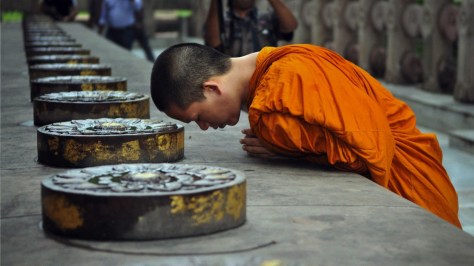
I can’t ask for anything; I have too much already.


You must be logged in to post a comment.